
Baba Yaga: Exploring the Ambiguous Archetype in Slavic Folklore
Introduction: The Enigmatic Figure of Baba Yaga
Deep within the birch forests of the Slavic imagination, there exists a figure who defies the simple categorizations of moral dualism. She is not merely a villain, nor is she a benevolent godmother. She is Baba Yaga-a name that evokes the creak of ancient wood and the chilling whistle of the wind. In the vast tapestry of Slavic oral tradition, Baba Yaga stands as one of the most complex and enduring figures, a character whose presence is felt as a visceral force of nature rather than a mere literary device. She is the wild personified, a creature of the threshold who exists on the periphery of the known world, guarding the boundary between the mundane and the metaphysical.
Her paradoxical nature is her defining characteristic. In some tales, she is the cannibalistic hag who threatens to roast the hero for dinner; in others, she is the wise donor who provides the essential magical tool or piece of advice required to complete a quest. This ambiguity is not a sign of narrative inconsistency but rather a reflection of the primordial forces she represents. To encounter Baba Yaga is to confront the terrifying and transformative power of the unknown. She represents the absolute indifference of nature and the demanding, often painful, process of maturation and initiation.
Defining the Archetype: Who is Baba Yaga?
Visually, Baba Yaga is a figure of grotesque intensity. She is often described as having a “bony leg” (Baba Yaga Kostyanaya Noga), a detail that suggests she has one foot in the world of the living and the other in the realm of the dead. Her nose is said to grow into the ceiling of her hut as she sleeps, her iron teeth are sharp, and her hair is wild and unkempt. Unlike the typical Western witch who flies on a broomstick, Baba Yaga travels in a giant mortar, steering with a pestle and sweeping away her tracks with a broom made of silver birch. This mode of transport is deeply grounded in the domestic reality of ancient Slavic life, yet elevated to the level of the supernatural.
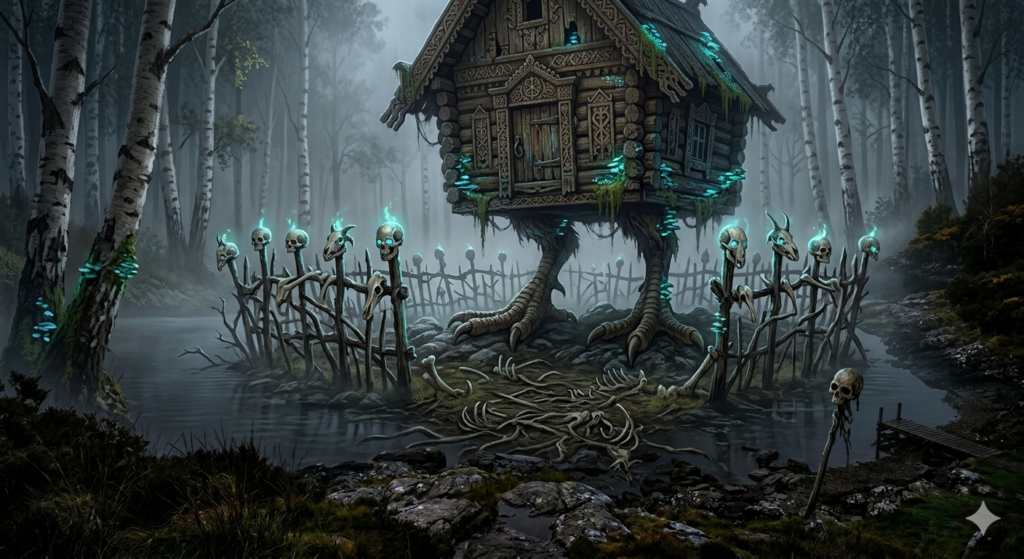
Her dwelling is perhaps the most iconic structure in world folklore: an izba (hut) that stands on giant chicken legs. This hut is a sentient, liminal space. It can spin and turn, often refusing to show its door until the traveler speaks the correct incantation: “Hut, hut, turn your back to the forest and your front to me.” Surrounding the hut is a fence made of human bones, topped with skulls whose eye sockets glow with an eerie, phosphorescent light. This imagery marks her clearly as a guardian of the threshold. She is the gatekeeper of the “Otherworld,” and her hut serves as the transition point between the domestic safety of the village and the transformative danger of the deep wild.
It is important to distinguish Baba Yaga from the generic witches of Western European fairy tales. While the Grimm-style witch is often a manifestation of pure malice or a cautionary tale about greed and vanity, Baba Yaga is a force of cosmic balance. She does not seek out victims; the protagonists usually find their way to her through necessity. She is a judge as much as a predator, testing the courage, wit, and politeness of those who cross her path. If the visitor is found wanting, they are consumed; if they are found worthy, they are enlightened.
Historical Context and Origins
The origins of Baba Yaga are buried deep in the Proto-Slavic past, predating the Christianization of Eastern Europe. Scholars suggest she may be a fragmented descendant of an ancient Great Mother goddess or a personification of death and the earth. In many early agrarian societies, the goddess of fertility was also the goddess of the grave-the earth that gives life must also eventually reclaim it. Baba Yaga’s connection to the forest and her command over the elements (she is often accompanied by three horsemen representing Day, Night, and the Sun) point toward a prehistoric status as a powerful deity of the natural cycle.
In her pagan roots, Baba Yaga functioned as a liminal guardian. The forest was the site of survival, but also of spirits and ancestors. As Slavic society evolved, these potent deities were often marginalized. With the advent of Christianity, the old gods were frequently demonized or relegated to the realm of “folk belief.” Baba Yaga, however, proved too resilient to be fully transformed into a demon. Instead, she evolved into the complex figure of the folktale-a repository of ancient wisdom and ancient terror who exists outside the moral framework of the church.
This evolution through the centuries allowed her to absorb various regional influences. Across the Slavic world-from the Russian North to the Balkans-variations of the name (Baba Jaga, Ježibaba) and her attributes appear, yet the core essence remains: she is the old woman of the woods who knows the secrets of the world before the advent of man-made laws.
Symbolic Interpretations and Analytical Frameworks
From a symbolic perspective, Baba Yaga embodies the concept of the “Terrible Mother.” She is the destroyer and the giver, reflecting the dual nature of the womb and the tomb. In the psychological framework of Carl Jung, she is a potent manifestation of the Crone archetype. As the Crone, she represents the third stage of feminine life, characterized by the accumulation of wisdom that comes through the experience of loss and the proximity to death. She is also a manifestation of the Shadow-the unacknowledged, dark, and wild aspects of the psyche that the conscious mind fears but must integrate to achieve wholeness.
Nature symbolism is woven into every aspect of her mythos. She is the personification of the wilderness-a place that does not care for human morality or survival. The forest is a chaotic space where life feeds on life. By residing in the center of this wildness, Baba Yaga serves as the personification of the cycles of life and death. Her hunger is the hunger of the earth, and her wisdom is the wisdom of the seasons. To interact with her is to interact with the raw, unrefined reality of existence.
Perhaps her most significant role is her function in the hero’s journey as the initiator of the rite of passage. In folk narratives, the protagonist (often a young girl or a youngest son) must leave the safety of home and enter the forest. This is the classic separation phase of initiation. Baba Yaga provides the ordeal. By surviving her tests-which often involve performing impossible domestic tasks or answering riddles-the protagonist undergoes a symbolic death of their former, childhood self and is reborn as an adult endowed with new power or insight.
Baba Yaga in Traditional Narratives
One of the most famous examples of this initiatory role is found in the tale of Vasilisa the Beautiful. Sent by her cruel stepmother to fetch light from the hut of Baba Yaga, Vasilisa must navigate the terrifying presence of the hag. Baba Yaga sets her to work, demanding she sort grains and clean the hut under the threat of death. Guided by a magical doll (a symbol of ancestral or maternal blessing), Vasilisa completes the tasks. Ultimately, Baba Yaga gives her a skull with glowing eyes to serve as a lantern. When Vasilisa returns home, the light from the skull incinerates her wicked stepfamily. Here, Baba Yaga acts as the catalyst for justice, providing the fire that purifies the protagonist’s life of its oppressors.
Variations across Slavic regions further emphasize her complexity. In some stories, there are actually three Baba Yagas-sisters who share a name and a territory, representing a triple-goddess motif or the repetitive, cyclical nature of her wisdom. In the tale of The Frog Princess, she acts almost entirely as a helper, providing the hero, Prince Ivan, with the directions and items needed to rescue his wife from Koschei the Deathless. In these instances, she is the “Wise Old Woman,” the keeper of secrets that even the villains fear.
Modern Relevance and Cultural Impact
In the modern era, Baba Yaga has transcended her folkloric origins to become a versatile cultural icon. She appears in literature, art, and music, perhaps most notably in Modest Mussorgsky’s “Pictures at an Exhibition,” where the movement “The Hut on Fowl’s Legs” captures her frantic, predatory energy. In contemporary literature, writers have reclaimed her as a proto-feminist figure-a woman who lives entirely on her own terms, beholden to no patriarch, and possessing a terrifying agency that society traditionally denies to aging women.
Her symbolic power remains relevant because she represents the “wild” that still exists within the human psyche. In a world of increasing urbanization and digital mediation, Baba Yaga reminds us of our connection to the earth and the inevitable reality of our own mortality. She has become a shorthand for a certain kind of fierce, uncompromising independence. Whether she is being invoked in film (as a nickname for a relentless assassin in John Wick) or explored in psychological studies, she remains the archetype of the necessary shadow-the part of the truth that we are afraid to look at, but which holds the key to our growth.
Conclusion: The Enduring Ambiguity of Baba Yaga
Baba Yaga remains one of the most fascinating figures in world mythology precisely because she cannot be pinned down. She is the mother who feeds and the monster who eats; the teacher who instructs and the executioner who punishes. She is a personification of the liminal space where life meets death and where the human meets the divine. Her enduring presence in Slavic culture and her global recognition speak to the fundamental human need for archetypes that reflect the complexity of our own nature.
Ultimately, Baba Yaga is a reminder that wisdom is often found in the most frightening places. She teaches that to obtain the light-represented by the glowing skull she gives to Vasilisa-one must be willing to enter the dark forest, face the hag, and endure the trial. She is the embodiment of the ambiguous truth that destruction and creation are two sides of the same coin, and that the path to transformation always leads through the threshold of the unknown.
Von Franz, M. L. (1970). Shadow and Evil in Fairy Tales. Shambhala Publications.nWarner, E. (2002). Russian Myths. British Museum Press.nZipes, J. (2015). The Oxford Companion to Fairy Tales. Oxford University Press.. Afanasyev, A. (1945). Russian Fairy Tales. Pantheon Books.nHubbs, J. (1988). Mother Russia: The Feminine Myth in Russian Culture. Indiana University Press.nJohns, A. (2004). Baba Yaga: The Wild Witch of the East in Russian Fairy Tales. University Press of Mississippi.nPropp, V. (1968). Morphology of the Folktale. University of Texas Press..Disclaimer.
This analysis explores Baba Yaga as a folkloric and psychological archetype. Descriptions of mythological figures are based on oral traditions and symbolic interpretations rather than historical claims.
Oraclepedia is an independent educational and cultural project. The material presented explores myths, belief systems, symbolic traditions, and aspects of human perception from historical, cultural, and psychological perspectives.
Content is provided for informational and reflective purposes only and does not promote specific beliefs, spiritual practices, or ideological positions. Interpretations presented reflect scholarly, cultural, or symbolic analysis rather than factual claims about the natural world.