
The Drosoulites: The Ghostly Shadows of Fragokastello, Crete
The Fortress by the Libyan Sea
Along the southern coast of Crete, where the land falls away into the deep indigo of the Libyan Sea, there stands a silent sentinel of stone known as Fragokastello. It is a lonely place, caught between the jagged shadows of the White Mountains and the endless horizon of the water. The fortress was built by the Venetians centuries ago, its rectangular walls and square towers intended to ward off pirates and keep the rebellious spirit of the Sfakian people in check. But time and the salt-laden winds have stripped the castle of its original purpose, leaving behind a hollow shell that guards nothing but the shifting sands and the secrets of the earth.
The ground here is a pale, fine dust that turns to gold in the afternoon sun and a ghostly silver under the moon. For much of the year, the only sounds are the rhythmic pulse of the waves against the shore and the occasional cry of a hawk circling the battlements. It is a landscape defined by stillness, a place where the heat of the day lingers long into the evening and the morning air is often heavy with a peculiar, cooling mist. In this quiet corner of the world, the veil between what was and what is seems to thin, especially when the season turns toward the heat of summer.
The Arrival of the Rebels
In the spring of 1828, the silence of Fragokastello was broken by the thunder of hooves and the steady march of determined men. The Greek War of Independence was raging, and the spirit of revolution had set the island of Crete ablaze. Leading a band of nearly six hundred men was Hadjimichalis Dalianis, a commander of great renown from Epirus. He was a man of tall stature and iron will, leading a force of cavalry and infantry into the heart of Sfakia to bolster the local resistance against the Ottoman forces.
They arrived in May, when the wild thyme and sage were in full bloom, scenting the air with an earthy sweetness that masked the looming scent of iron and gunpowder. The rebels took up their positions within the ancient walls of Fragokastello, though the fortress was never designed for modern warfare. Its walls were crumbling, and the vast open plain surrounding it offered little cover against an advancing army. The Sfakian locals, wise in the ways of mountain warfare, urged Dalianis to take to the high ground, to the narrow passes where a few men could hold back a thousand. But Dalianis was a man of traditional honor; he chose to stand his ground behind the stone battlements, facing the sea and the coming storm.
The Gathering Storm
The night before the battle was unnaturally still. The rebel soldiers sat by small fires, the flickering light casting long, dancing shadows against the Venetian masonry. Some sharpened their yatagans, the curved blades glinting like crescent moons, while others checked the flintlocks of their rifles. There was little talk. The weight of their choice hung heavy in the air. They knew that Mustapha Pasha, the governor of Crete, was approaching with a force that vastly outnumbered their own-thousands of infantry and cavalry, disciplined and well-supplied.
Dalianis walked among his men, his presence a steadying force. He looked out from the ramparts toward the mountains, where the shadows of the peaks seemed to lean forward, as if watching the small band of men below. The sea was a dark, unmoving mirror. There was no wind, no sound of crickets, only the heavy, humid breath of the coming summer. In those final hours of peace, the soldiers slept on the hard stone and the dry earth, their dreams filled with the faces of families left behind and the harsh beauty of the land they sought to reclaim. They were men bound by a common vow, standing on a narrow strip of sand between the mountains they loved and the sea that offered no escape.
The Sacrifice Beneath the Walls
When the sun rose on the 17th of May, it did not bring warmth, but the harsh glare of an impending slaughter. The Ottoman army appeared on the horizon like a dark tide, their banners snapping in the morning breeze. The air was soon filled with the roar of cannons and the sharp crack of musketry. For seven days, the plains of Fragokastello became a theater of desperation and valor. The rebels fought with a ferocity born of the knowledge that there would be no retreat.
On the final day of the conflict, the gates of the castle were breached. Dalianis himself led a final, desperate charge out onto the sand, his white horse standing out against the smoke and the dust. He fought until his blade was notched and his strength spent, falling eventually beneath the sheer weight of the opposing numbers. His men followed him into the fray, refusing to lay down their arms even as the sands turned crimson. One by one, the defenders were cut down beneath the very walls they had sworn to protect. By the time the sun began to set, the battle was over. The Ottoman forces moved on, leaving the fallen where they lay. No graves were dug that evening; the wind was the only mourner, beginning its slow work of covering the bodies with the fine, white dust of the Cretan shore.
The Rising Shadows
Days passed, and then years. The castle returned to its state of quiet decay, the stones bleaching in the sun and the salt air eating away at the mortar. But the memory of the massacre did not fade from the land. It was the local shepherds who first noticed the change. In the late days of May and the early mornings of June, when the air is cool and the dew-the ‘drosia’-lies heavy on the ground, something strange begins to happen near the ruins of Fragokastello.
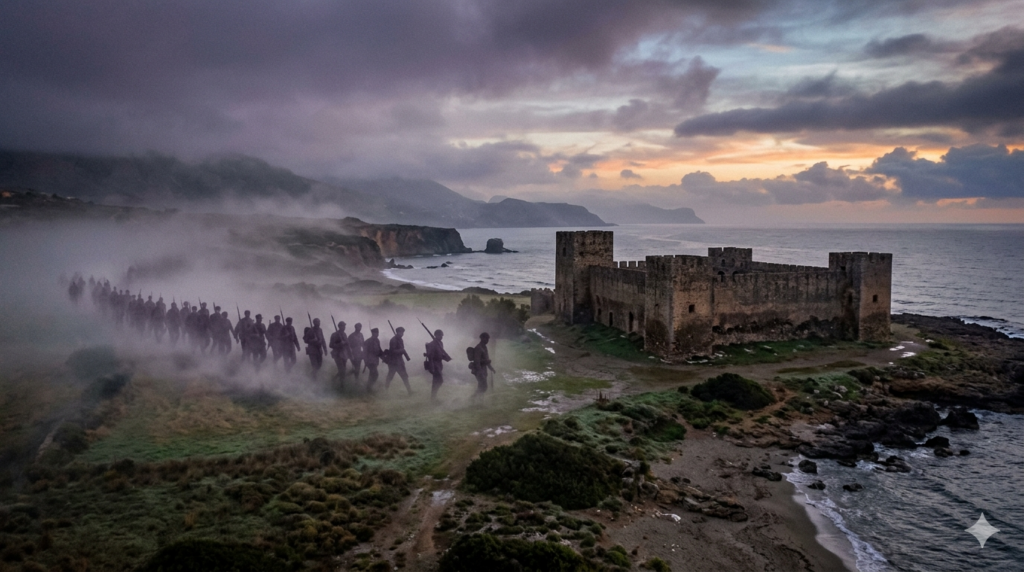
As the first light of dawn touches the horizon, a thick, low-lying mist often rolls in from the sea, hugging the earth and obscuring the line between the water and the shore. It is from this mist that the Drosoulites-the ‘Dew Men’-emerge. They are not figures of flesh and bone, but shadows of deep violet and charcoal gray. They appear as a long procession of soldiers, some on horseback and others on foot, clad in the traditional garb of the rebels with their kilts and their rifles. They move with a rhythmic, silent grace, marching from the old monastery of Saint Charalambos toward the castle walls.
There is no sound of boots on the sand, no jingle of harness, no shout of command. They move as one, a phantom army caught in a moment of eternal transit. Those who have seen them speak of a profound chill that accompanies their passing, a stillness so deep that even the birds fall silent. The figures are translucent, yet they possess a terrifying clarity; the shape of a plumed helmet, the silhouette of a long-barreled gun, the proud tilt of a commander’s head can all be discerned through the shifting haze of the morning air.
The Eternal March
The Drosoulites do not speak, and they do not acknowledge the living. They belong to the hour of the dew, that fleeting bridge between the darkness of night and the clarity of day. They march for ten minutes, perhaps twenty, their forms growing more distinct as the light increases, only to vanish the very instant the sun’s disk clears the horizon. As the first direct ray of golden light hits the towers of the castle, the shadows dissolve back into the mist, and the mist itself evaporates into the warming air.
They appear every year, though not to everyone. Only when the atmospheric conditions are perfect-when the sea is calm, the humidity is high, and the wind is still-does the earth yield its memory. They are seen by fishermen returning with their night’s catch and by farmers tending to their flocks in the early light. The locals do not fear them; to the people of Sfakia, the Drosoulites are not ghosts to be exorcised, but a part of the landscape itself. They are the guardians of the shore, a recurring vision of a debt paid in blood and a spirit that refuses to be buried by the sand.
As the sun rises higher, the castle of Fragokastello stands once more in its solitary grandeur. The plains are empty, the sand is undisturbed, and the Libyan Sea sparkles with a thousand points of light. The shadows have retreated, waiting for the next morning of heavy dew to rise again from the earth, continuing their silent, endless march through the mists of time.
Folklore of the Cretan Countryside by various collectors; Legends of the Greek War of Independence. Traditional Cretan oral narratives and local historical folklore.Disclaimer.
This article explores oral traditions and historical folklore. The Drosoulites are presented as a cultural phenomenon and legend rather than a scientifically verified event.
Oraclepedia is an independent educational and cultural project. The material presented explores myths, belief systems, symbolic traditions, and aspects of human perception from historical, cultural, and psychological perspectives.
Content is provided for informational and reflective purposes only and does not promote specific beliefs, spiritual practices, or ideological positions. Interpretations presented reflect scholarly, cultural, or symbolic analysis rather than factual claims about the natural world.