
The Shadow in the Stillness: The Legend of the Loch Ness Monster
The Great Glen and the Iron-Dark Water
In the heart of the Scottish Highlands, where the mountains rise like sleeping giants draped in heather and gorse, there lies a long, narrow fracture in the earth known as the Great Glen. Within this deep trench rests a body of water that is unlike any other. Loch Ness stretches for miles, a ribbon of liquid shadow cradled by steep, pine-shrouded slopes. Its waters are not clear; they are stained the color of dark tea or aged iron by the peat that washes down from the surrounding moors. To look upon the surface is to see a mirror that reflects the shifting clouds and the flight of the osprey, yet beneath that skin of silver lies a cold, lightless world that descends hundreds of feet into the bedrock.
For as long as there have been people to walk the shores of the Great Glen, there has been a feeling that the loch is not truly empty. It is a place of heavy silence, where the air often hangs still and the only sound is the rhythmic lap of the water against the grey stones. Even on the brightest summer days, the water remains biting cold, a reminder of the ancient glaciers that carved this place from the stone. The locals have always known that the loch keeps its secrets well, tucked away in the crevices of the underwater cliffs where the sun’s rays can never reach. It is a landscape that invites the imagination to wonder what might dwell in the stillness between the ripples.
The First Ripple
The stories of the water-beast go back many centuries, to a time when the land was a patchwork of kingdoms and the old ways still held sway. The first written account belongs to the era of the saints, specifically to a man named Columba who had traveled from Ireland to bring his faith to the Picts. In the year 565, Columba and his companions reached the banks of the River Ness, which flows from the loch toward the sea. As they prepared to cross, they came upon a group of local people burying one of their own. When Columba asked what had happened, they spoke of a monster, a creature of the water that had fallen upon the man while he was swimming and bitten him with great ferocity.
Seeking to prove the power of his word, Columba did not turn away in fear. Instead, he instructed one of his followers, a man named Lugne, to swim across the river and bring back a boat from the far side. Lugne obeyed, stripping off his tunic and diving into the cold current. As the man reached the middle of the river, the water began to churn. From the depths, a great beast rose, its back humped and its skin glistening like wet stone. It let out a roar that echoed against the hills and lunged toward the swimmer with its jaws agape. The people on the bank cried out in terror, believing Lugne was lost to the same fate as the man they had just buried.
Columba, standing on the shore, raised his hand and made the sign of the cross in the air. He commanded the creature to go no further and to touch the man no more. He told the beast to return at once to the depths from whence it came. To the astonishment of all who watched, the creature checked its advance as if it had been pulled back by invisible ropes. It shook its massive head and dove beneath the surface, leaving only a trail of bubbles and a widening circle of waves. Lugne reached the boat safely and returned to the shore. From that day, the tale of the monster in the Ness became a part of the land itself, a story whispered by firesides while the wind howled through the glens.
The Growing Whispers
As the centuries passed, the memory of Columba’s encounter did not fade, but rather grew into a tapestry of local lore. The people of the Highlands spoke of the water-kelpie, a shapeshifting spirit that inhabited the deep lochs of Scotland. In some stories, the creature appeared as a magnificent black horse that tempted the weary traveler to mount its back, only to gallop into the depths and drown its rider. In others, it was described as a great serpent or a long-necked beast that moved through the water with the grace of a swan but the power of a leviathan. These were not merely stories to frighten children; they were a way of respecting the power and the danger of the water.
Farmers tending their sheep on the high ridges would sometimes look down and see strange wakes cutting through the glassy surface when there was no wind to cause them. Fishermen spoke of their nets being torn by something far larger and stronger than any salmon or pike. There were accounts of logs that suddenly grew heads and swam against the current, and of dark shapes that basked on the pebbled beaches at dawn, only to slide back into the safety of the peat-dark water the moment a human footfall was heard. These whispers formed a collective understanding: the loch was a doorway to another world, and its guardian was a shadow that lived in the stillness.
The Encounter in the Mist
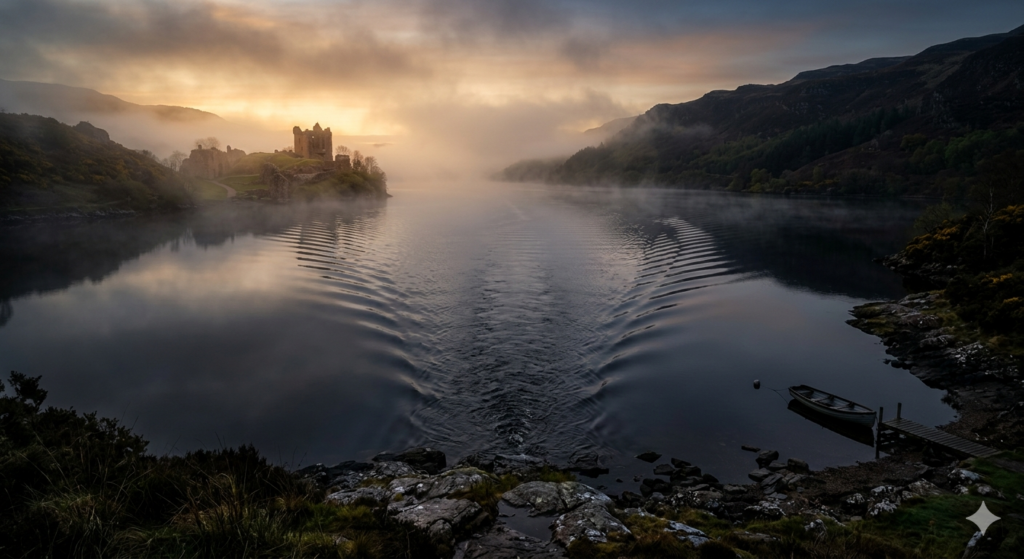
The legend took on a new life in the modern age, as roads were carved into the hillsides and more eyes were turned toward the water. One morning, when the mist lay thick and white over the loch like a woolen blanket, a traveler stood on the northern shore near the ruins of Urquhart Castle. The air was damp and smelled of wet earth and pine needles. For a long time, there was nothing to see but the shifting grey vapor and the dark line where the water met the shore. Then, the sun began to break through, casting a pale, golden light that burned away the fog in patches.
In one of these clearings, about a hundred yards from the bank, the water began to heave. It was not the splash of a leaping fish, but a slow, heavy displacement. A long, slender neck rose out of the loch, dripping with water that shimmered like diamonds in the morning light. The head was small and tapered, and as it rose higher, a large, dark hump followed it, breaking the surface like the hull of an upturned boat. The creature moved with a silent, undulating motion, creating a V-shaped wake that stretched out toward the center of the loch. The witness stood frozen, breathless, watching the impossible shape glide through the water. It was a sight of ancient majesty, a relic of a time before maps and machines. The creature did not seem aggressive; it simply existed, a living part of the primeval landscape, as natural as the mountains and the rain.
The Return to the Deep
As quickly as it had appeared, the creature began to descend. It did not dive with a great splash, but rather sank with a quiet grace, as if it were being reclaimed by the water itself. The neck lowered slowly, the hump smoothed out, and the ripples began to flatten. Within moments, the surface of the loch was as smooth as a sheet of dark glass once more. The traveler watched for a long time, waiting for another sign, but the water remained untroubled. The only evidence that anything had happened was the soft lapping of the wake as it finally reached the shore, washing over the pebbles with a gentle hiss.
The silence returned to the Great Glen, deeper and more profound than before. The loch had opened its curtain for a fleeting second and then pulled it shut, keeping its mysteries tucked away in the cold, dark depths. There were no photographs to be taken in that moment, no measurements to be made; there was only the memory of a shadow and the feeling of having glimpsed something that belonged to the earth’s hidden history. The monster-if that was the right word for such a creature-had gone back to the stillness where it had lived for a thousand years.
The Silent Guardian
Today, as the sun sets over the peaks of the Highlands, the shadows of the mountains stretch long and dark across the surface of Loch Ness. The water turns from iron-grey to a deep, bruised purple, and then to a black that matches the night sky. The lights of the small villages along the shore twinkle like fallen stars, but the center of the loch remains a void of shadow. It is a place where the modern world feels thin, and the ancient world feels very close.
The legend persists because the loch itself persists. It is too big, too deep, and too dark to ever be fully known. As long as the peat-stained waters remain cold and the Great Glen stands firm, people will continue to stand on the shore and peer into the distance. They will look for the ripple that shouldn’t be there, the hump that rises against the current, and the long neck that breaks the surface in the morning mist. The creature remains the silent guardian of the Glen, a reminder that there are still places in this world where the unknown is allowed to dwell, and where the shadows in the stillness have their own stories to tell.
Further Reading
Adamnan’s Life of Saint Columba; The High History of the Scottish Highlands; Celtic Myths and Legends by T.W. Rolleston.
Sources & References
Adomnán of Iona, Vita Columbae (Life of Columba), c. 700 AD; Scottish Folklore and Folk Belief collections from the 19th and early 20th centuries.
Adamnan’s Life of Saint Columba; The High History of the Scottish Highlands; Celtic Myths and Legends by T.W. Rolleston. Adomnán of Iona, Vita Columbae (Life of Columba), c. 700 AD; Traditional Highland oral narratives.Disclaimer.
This article explores the cultural and narrative history of the Loch Ness Monster as part of Scottish oral tradition. It is presented for educational purposes and does not claim to provide empirical evidence of the creature's existence.
Oraclepedia is an independent educational and cultural project. The material presented explores myths, belief systems, symbolic traditions, and aspects of human perception from historical, cultural, and psychological perspectives.
Content is provided for informational and reflective purposes only and does not promote specific beliefs, spiritual practices, or ideological positions. Interpretations presented reflect scholarly, cultural, or symbolic analysis rather than factual claims about the natural world.